 JPX product Sprint-start coach for iPhone
Blockwork One
Your start, measured.
- Scope
- Product, design & engineering
- Practice
- JPX product
- Delivered
- In TestFlight
- Status
- In development
The brief
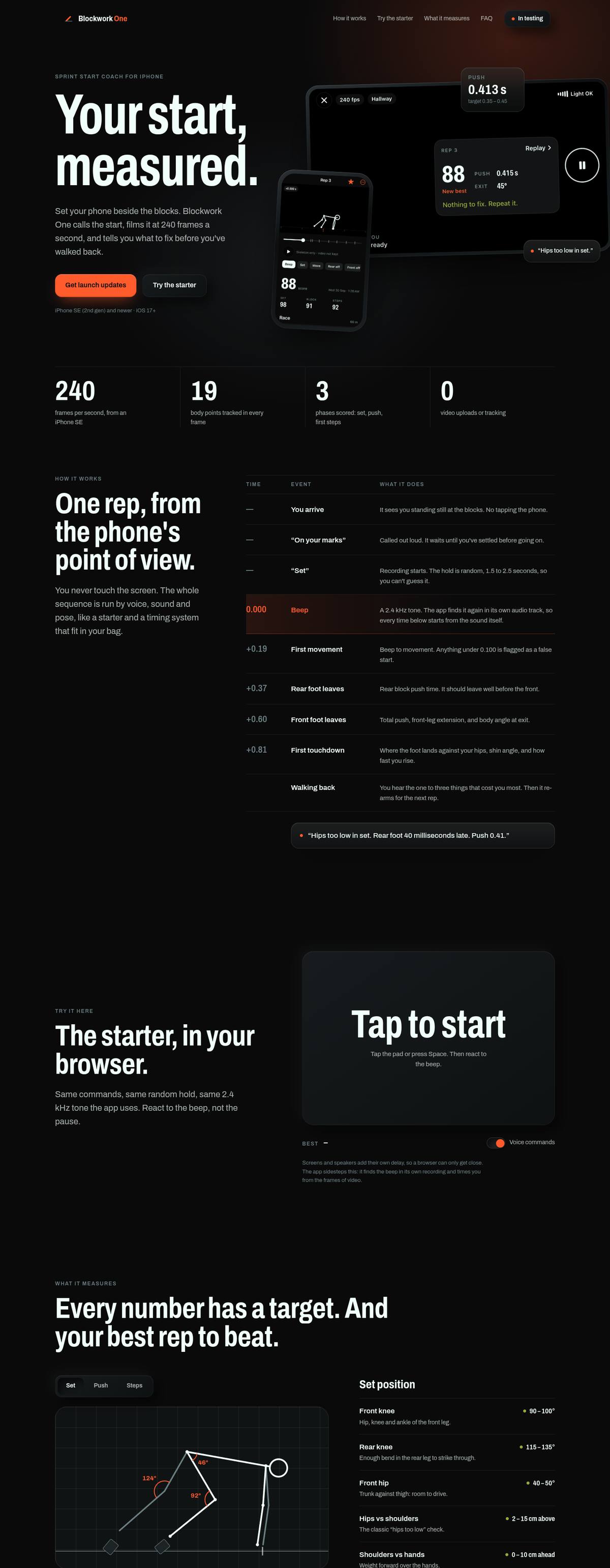
A sprinter training alone has no one to call the start, no way to see their own set position, and no timing better than a stopwatch. Blockwork One turns an iPhone propped beside the lane into the starter, a high-speed camera, and a coach — scoring the set, the push, and the first steps of every rep against the athlete's own best, without them touching the phone.
Built with
- Swift
- SwiftUI
- AVFoundation
- Vision
- SwiftData
- StoreKit 2
- React
- Vite
- Vercel
- blockworkone.com
Colophon
Timing
The beep is scheduled on the audio engine at an exact host time. After the rep, the recorded microphone track is searched for the 2.4 kHz tone and that is the moment used — audio and video share one clock, so reaction and push times are measured against what the athlete actually heard.
Pose
Apple's Vision body-pose model runs across a window starting half a second before the beep. In a side view it often swaps left and right legs, so legs are re-labelled by motion continuity, and positions are smoothed with a Savitzky–Golay filter before any velocity is taken.
Coaching
Every rep is scored across the set, the push, and the first steps against reference ranges, then spoken back as one to three cues. Session summaries surface the faults that keep repeating, and trends compare you with your own best.
Engine
The analysis engine is pure Swift with no Apple frameworks, so it is tested on Linux CI against a synthetic sprinter rather than only by hand on a track.
No backend
On purpose. Pose estimation, storage, and subscription checks all run on the phone, so video never leaves it and the product costs nothing to operate per user.
Release
TestFlight builds are signed and uploaded from CI, and every screen is re-rendered on a simulator by the pipeline, so store screenshots never drift from the shipping interface.
Try it
The app starts with a starter: marks, set, a random hold, a beep. Here's the browser version — sound on.
Best —
The problem with training alone
A block start lasts well under a second, and almost everything that matters in it is invisible from inside it: where your hips sit in the set position, whether the front leg finishes its push, whether your first step lands underneath you or in front. A coach sees it. A sprinter on their own sees nothing — and has nobody to call the start in the first place.
Hands-free, by design
You can't hold a phone and get into blocks, so the whole loop runs without a touch. Prop it on its side, tap Start, walk to your mark. It calls you up, waits until you've settled, calls set, holds a random interval, and fires. By the time you've walked back, it has found the beep in the recording, tracked your body through the start, scored the rep, and said out loud what to fix next.
Honest numbers
Every measure has a stated target range and a reason, and anything the camera can't measure reliably — like reaction time, which reads later than a block sensor — is tracked rather than graded. When it's too dark to find you, it says so and switches to a timed start instead of inventing a result.
Next project
NH Small Claims
Small claims court, explained in plain language.